
Forestry operations at Beechenhurst
We will be timber harvesting in Beechenhurst from 2 June 2026
The works will impact some of our trails and access points. This page provides more information about the work we are doing and why.
What is happening?
We will be thinning trees to give the strongest and healthiest trees more space to grow, and to allow more light to the woodland floor. The stumps will be left, they will rot down and provide nutrients back into the soil. Any left brash and deadwood will provide habitat for wildlife and nutrients to the soil as it rots. No clear felling will be taking place.
The timber produced by this operation will go into the construction industry, fencing, wood panel manufacture for furniture and firewood. Some crown wood will be left on site as wildlife habitat, known as ‘dead wood.’
When we take the wood away from the site we will do our best to use existing routes to minimise the damage to the forest floor, which is inevitable due to the size of the machinery that must be used. Any damage to these routes will be repaired where necessary when the work is completed.
We anticipate all works to be completed within the week (1 to 7 June). Harvesting contracts can take some time and work may have to be paused due to the many constraints that we have to work around. Please bear with us as we carry out this work. We will try to do so with minimal inconvenience to our visitors.
Will you be replanting?
We do not have plans to replant because we aren't clearing a large area. By selectively removing some trees we give those that remain more space and light to carry on growing. Eventually we might harvest the mature trees. This is all part of the forest lifecycle and it helps us develop robust, healthy and diverse forest areas.
Can I still visit Beechenhurst?
Yes, Beechenhurst will remain open throughout our harvesting operations, but the most important thing for us is to keep the public, our staff, and contractors safe.
Forestry work is very hazardous, so we will have safety and operational signage displayed, closures, and banks persons in position where needed. A falling tree can weigh several tonnes and hit the ground at nearly 60mph. If a harvesting machine chainsaw snaps, it can fly through the forest like a bullet.
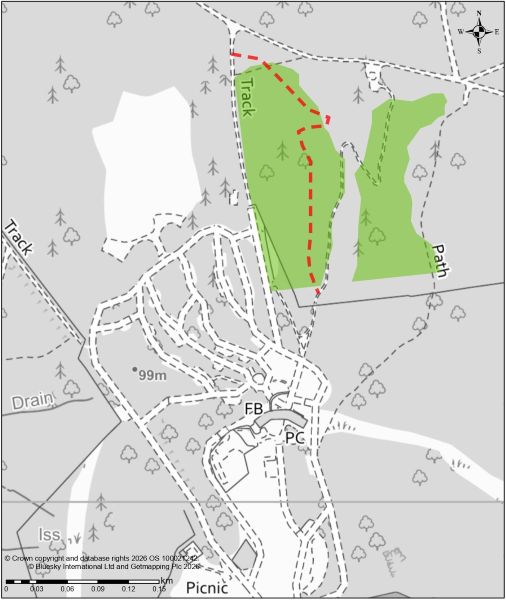
A temporary trail closure on the Glade Trail will be in place while operators are working (see below map – the green areas are where we will be harvesting, and the red dashed line is the trail closure), however we will do our best to reopen the trail as soon as it is safe to do so. This is for the safety of forest users and workers, so please take note of all signage and be prepared to turn around if asked to do so.
The play area and cafe will be open whilst the work takes place.
What about the wildlife?
Well managed forests are able to support more wildlife, and harvesting trees is an important part of a sustainable forest lifecycle.
Before we start any forestry work, a survey is carried out to check for species such as birds, mammals, rodents, invertebrates, and native plants. We also consider these against complex factors including tree health, ground conditions and likely rainfall when planning work that will support our long-term management plan.
While working, we continue to check for wildlife and will adapt, pause or suspend work if we find any animal that must be protected.
Why is this work being completed in spring/summer months?
As you can imagine, there is no "safe" time of year when nothing will be disturbed. In order to support the rural economy, we must continue to work throughout the year. It is important for us to balance competing objectives in order to keep contractors employed for the greater good of the woodland as a whole. We also cannot physically complete our programme of work outside of the nesting season.
The small part of the forest that is worked through the nesting season are in areas of lower risk, which then leaves the vast majority of the forest undisturbed for wildlife. Parts of this woodland are also known to be soft and the ground becomes too wet for the machinery to operate during the winter months.
If you would like any further information, please get in touch via westengland@forestryengland.uk